
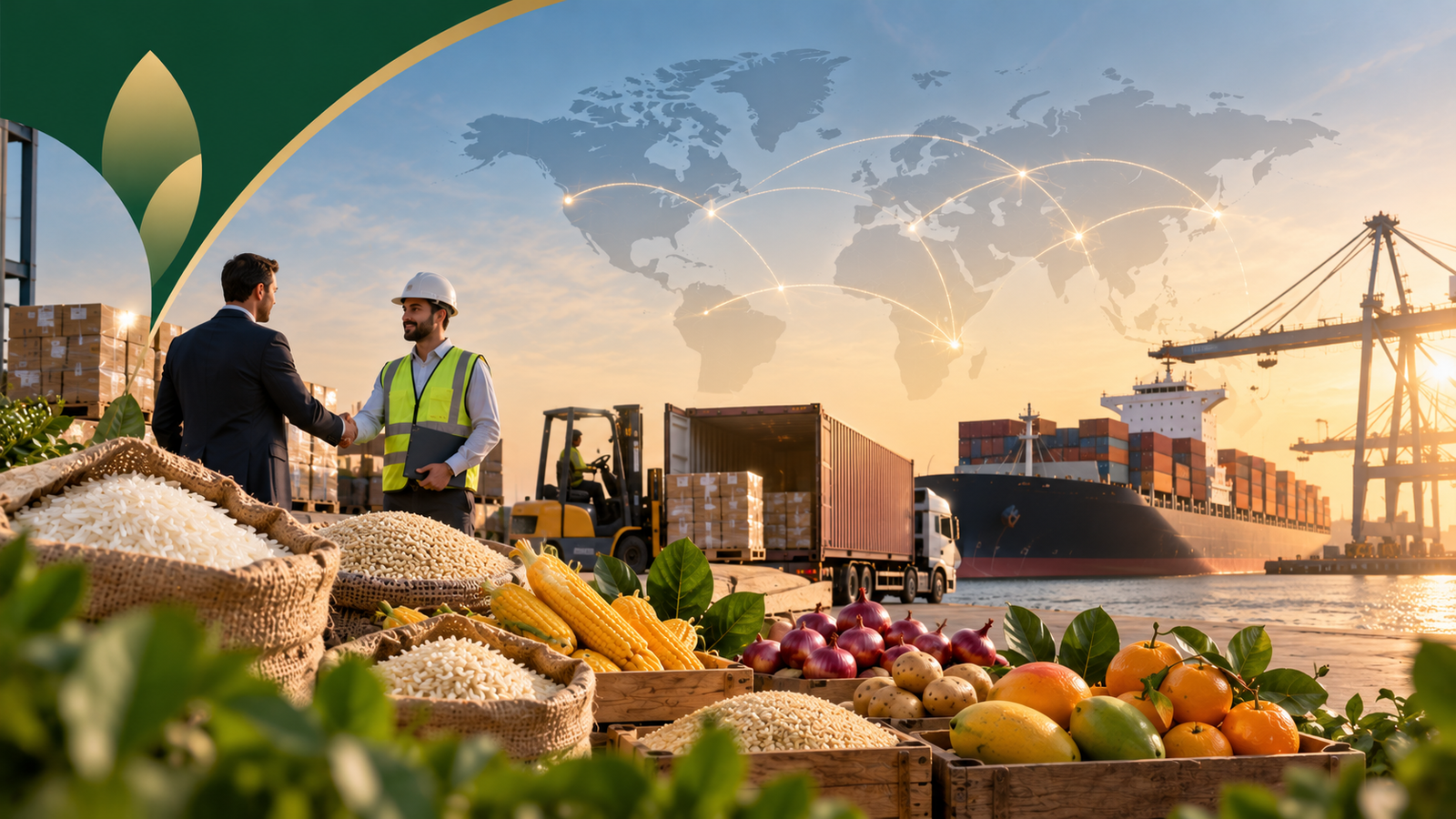
What International Buyers Expect From Export Suppliers in 2027
Global trade is changing, and so are the expectations of international buyers. For many years, exporters could compete mainly through price, product quality, and the ability to deliver large volumes. These factors still matter, but they are no longer enough on their own.
As businesses prepare for 2027, buyers are paying closer attention to where products come from, how they are produced, whether suppliers can prove compliance, and how well they can respond when supply chains face disruption.
This change is especially important for agricultural products, food, livestock products, raw materials, and other goods moving through complex international supply chains.
The best export suppliers in 2027 will not simply sell products. They will provide buyers with confidence.
That confidence will come from consistent quality, traceability, reliable delivery, clear documentation, responsible business practices, and professional communication.
- What Do International Buyers Look for in Export Suppliers?
- 1. Consistent Quality Will Remain a Basic Requirement
- 2. Traceability Will Become More Important
- 3. Compliance Will Become Part of the Buying Decision
- 4. Buyers Will Expect Greater Supply Reliability
- 5. Clear Documentation Will Be a Competitive Advantage
- 6. Responsible Sourcing and Due Diligence Will Matter More
- 7. Sustainability Must Be Supported by Evidence
- 8. Buyers Will Expect Faster and Better Communication
- 9. Digital Capability Will Influence Supplier Relationships
- 10. Flexibility Will Matter Alongside Scale
- 11. Buyers Will Look for Long-Term Partners, Not Just Traders
- 12. Competitive Pricing Still Matters, but It Is Not Everything
- How Can Export Suppliers Prepare for 2027?
- What Should International Buyers Ask Before Choosing an Export Supplier?
- The Export Supplier of 2027 Will Sell Confidence
- Iqbal Group: Building Trusted Connections With Global Markets
- FAQs
What Do International Buyers Look for in Export Suppliers?
International buyers want suppliers that reduce risk. Price remains important, but a low price has limited value if the shipment is delayed, specifications change, documents are incomplete, or the supplier cannot meet the importing country’s requirements.
Professional buyers therefore evaluate the complete supplier relationship.
They may consider product quality, production capacity, certifications, traceability, compliance, delivery performance, financial stability, communication, sustainability practices, and the supplier’s ability to solve problems.
This means exporters need to think beyond the first order.
The real goal should be to become a supplier that international buyers are comfortable working with for years.
1. Consistent Quality Will Remain a Basic Requirement
Quality is one of the first things international buyers expect, but consistency is what creates long-term business.
A buyer does not want one excellent shipment followed by three average ones.
If a contract defines product size, grade, moisture, purity, packaging, weight, colour, processing method, or another specification, the supplier should be able to meet those requirements repeatedly.
Why Consistency Matters More in International Trade
Importers often supply other businesses. An agricultural importer may supply wholesalers, retailers, food processors, restaurants, or manufacturers. If the exporter changes the product specification without warning, the problem can affect several businesses further down the supply chain.
This is why professional export suppliers should have clear quality-control systems before goods leave the country.
For agricultural and food products, this may include inspections, laboratory testing, grading, sorting, food safety controls, and documented production procedures where applicable.
The exact requirements will depend on the product and destination market.
2. Traceability Will Become More Important
International buyers increasingly want to understand where a product came from and how it moved through the supply chain.
The OECD describes traceability as the ability to track and verify important information such as origin, geographical movement, chain of custody, and changes to a product as it moves through a supply chain.
This matters because buyers are facing greater expectations around supply-chain due diligence, environmental impact, labour practices, food safety, and regulatory compliance.
By 2027, suppliers that can provide reliable product information will be easier for many international buyers to assess.
What Does Traceability Mean for Exporters?
Traceability does not always require a complex digital platform. Depending on the industry, it can begin with good records covering sourcing, farms or production sites, batch numbers, processing, testing, storage, packaging, and shipment documentation.
The goal is simple.
If a buyer asks where a product came from, how it was handled, or which batch was shipped, the exporter should be able to provide a clear answer supported by records.
For food and agricultural export suppliers, this can also support faster action if a quality or food safety problem is discovered.
3. Compliance Will Become Part of the Buying Decision
Global trade rules are becoming more detailed in several markets. International buyers cannot ignore these requirements because they may carry legal responsibility for the products they import.
This means suppliers should understand the rules of the markets they want to enter.
The requirements can cover food safety, phytosanitary controls, labelling, packaging, product testing, environmental standards, human rights, customs documentation, and other areas depending on the product.
New Rules Are Increasing the Need for Supplier Data
Europe provides a clear example of this wider trend.
The EU Carbon Border Adjustment Mechanism entered its definitive phase in January 2026 for selected carbon-intensive goods. Importers covered by the system have reporting and certificate obligations linked to embedded emissions.
The EU Deforestation Regulation is another example. Its application begins from 30 December 2026 for large and medium-sized operators, with later dates applying to certain smaller operators and newly covered products.
Not every exporter or agricultural product falls under these regulations. However, they demonstrate a broader direction in global trade: importers increasingly need accurate information from businesses further up their supply chains.
Export suppliers that understand this change and maintain strong documentation will be better prepared for demanding international markets.
4. Buyers Will Expect Greater Supply Reliability
International trade continues to face uncertainty.
Geopolitical tensions, shipping disruptions, energy costs, trade policy changes, extreme weather, and other events can affect supply chains with little warning.
The World Trade Organization reported in September 2026 that global merchandise trade remained resilient, but it also highlighted continued geopolitical and trade-policy uncertainty.
For buyers, this makes reliability extremely important.
A supplier should know its production capacity, sourcing capabilities, inventory position, shipping options, and realistic lead times.
Making promises that cannot be kept may help secure one order, but it can damage the relationship when the shipment is due.
Strong export suppliers communicate early when conditions change and work with buyers to find practical solutions.
5. Clear Documentation Will Be a Competitive Advantage
International trade creates paperwork.
Depending on the product and destination, a shipment may require commercial invoices, packing lists, certificates of origin, health certificates, phytosanitary certificates, inspection reports, bills of lading, test reports, insurance documents, or other records.
Errors can create delays at customs and additional costs for the buyer.
This is why documentation should not be treated as a final administrative task after the sale.
Professional export suppliers should build documentation into their operating process.
The sales, quality, logistics, finance, and export teams should understand what documents are required and when they must be prepared.
For international buyers, accurate documentation signals that the exporter understands global trade.
Quick link: Why Pakistan Is Becoming a Global Poultry Export Hub
6. Responsible Sourcing and Due Diligence Will Matter More
Another major change is the growing focus on what happens further inside the supply chain.
The OECD’s Responsible Business Outlook 2026 found that environmental and human-rights considerations are increasingly being used in supplier selection among large listed companies.
According to the OECD analysis, 47% of large listed companies studied reported using environmental criteria when selecting suppliers, while 48% reported using human-rights criteria.
This does not mean every buyer will use the same standards in 2027.
It does mean export suppliers should expect more questions about how they operate and where they source from.
Buyers May Look Beyond the Direct Supplier
Due diligence is also moving beyond the immediate business relationship.
A buyer may want information about farms, processors, factories, subcontractors, or other businesses involved earlier in the supply chain.
For agricultural exporters, this makes stronger supplier relationships and sourcing records increasingly useful.
Export businesses that understand their own supply chains can answer buyer questions with greater confidence.
7. Sustainability Must Be Supported by Evidence
The word “sustainable” appears everywhere in international business.
By 2027, simply using the word will carry little weight with serious buyers.
Companies need evidence.
Depending on the industry, this could include information about energy use, water management, waste reduction, responsible sourcing, emissions, packaging, animal welfare, or environmental certifications.
Not every buyer will ask for every metric, and requirements vary by market and product.
The important point is that sustainability claims should be accurate and supported.
Export suppliers should avoid making broad claims they cannot prove.
A smaller, measurable improvement is more credible than an impressive statement without evidence.
8. Buyers Will Expect Faster and Better Communication
Good communication may sound simple, but it remains one of the strongest ways to build trust in international trade.
Buyers operate across different countries, time zones, languages, and business cultures. They need suppliers who respond clearly and professionally.
A buyer should not have to repeatedly ask for the same shipment update.
Export suppliers should communicate important information about production, inspection, documentation, shipping, expected arrival, and any problems that could affect the order.
Problems Should Be Communicated Early
Every international supply chain can face problems.
A shipment can be delayed. Weather can affect a crop. Freight costs can change. Production can fall below expectations.
Professionalism is not about pretending these problems never happen.
It is about communicating early, explaining the situation clearly, and presenting possible solutions.
Buyers remember how suppliers respond when something goes wrong.
9. Digital Capability Will Influence Supplier Relationships
Digital technology is changing global trade.
The WTO’s World Trade Report 2026 highlights the growing role of digitalisation and artificial intelligence in how international trade operates.
For export suppliers, digital capability does not mean replacing human relationships.
It means making those relationships easier to manage.
Buyers increasingly expect quick access to specifications, certifications, product information, shipment updates, invoices, quality reports, and other documents.
Exporters can use digital systems to improve inventory management, quality records, traceability, customer communication, documentation, and shipment visibility.
Companies that still depend entirely on disconnected spreadsheets, paper records, and individual employees may find it harder to meet the expectations of larger international buyers.
10. Flexibility Will Matter Alongside Scale
Large production capacity can be attractive, but buyers do not always want the same product in the same format.
Different countries can require different grades, packaging sizes, labels, specifications, documentation, and shipping arrangements.
The ability to adapt can therefore become an important advantage.
For agricultural products, one buyer may need bulk packaging for food processing while another requires a different grade for wholesale distribution.
A good supplier first understands the buyer’s intended use.
It then determines whether the required specification can be delivered consistently and commercially.
Export suppliers should never promise customisation that their operations cannot support, but practical flexibility can help build stronger buyer relationships.
11. Buyers Will Look for Long-Term Partners, Not Just Traders
International procurement is expensive.
Finding suppliers, checking samples, conducting due diligence, negotiating terms, approving documentation, and testing the first shipments all require time.
Once a buyer finds a dependable supplier, there is value in maintaining that relationship.
This creates an important opportunity for exporters.
Instead of approaching each transaction as a one-time sale, export suppliers should understand the buyer’s wider business.
What markets does the buyer serve? What problems do they face? Which specifications matter most? When does demand increase? What could make their supply chain more efficient?
A supplier that understands these questions can become more valuable than a business that only sends quotations.
12. Competitive Pricing Still Matters, but It Is Not Everything
International buyers will continue comparing prices in 2027.
Global sourcing makes this unavoidable.
However, buyers increasingly evaluate the total cost and risk of working with a supplier.
A cheaper product can become expensive if quality failures lead to rejected goods, late shipments cause shortages, documentation creates customs delays, or inconsistent supply forces the buyer to find an emergency alternative.
This is why professional suppliers should compete on value rather than price alone.
That value can include consistent quality, reliable supply, strong documentation, traceability, responsive service, efficient logistics, and reduced procurement risk.
How Can Export Suppliers Prepare for 2027?
Export suppliers preparing for 2027 should begin by looking at their business through the buyer’s eyes.
Can the company prove where its products come from? Can it maintain the agreed specification? Are quality systems documented? Does the team understand destination-market requirements? Can certifications and test reports be shared quickly? Are delivery timelines realistic? Does the business understand its own upstream suppliers?
Companies should also review how they manage sustainability information, due diligence requests, shipment visibility, and buyer communication.
The goal is not to create unnecessary paperwork. It is to make the business easier to trust.
Quick link: Top Agricultural Products Exported From Pakistan
What Should International Buyers Ask Before Choosing an Export Supplier?
International buyers should conduct proper checks before entering a long-term supplier relationship.
Important questions include whether the supplier has experience with the required product, whether it can meet the agreed specification, what quality controls are in place, where products are sourced, what certifications are available, and whether production capacity matches the buyer’s requirements.
Buyers should also understand the supplier’s logistics process, lead times, documentation capabilities, traceability systems, payment terms, and approach to resolving quality issues.
For regulated products, buyers should confirm that both the product and supplier meet the requirements of the destination market.
A strong supplier should be comfortable answering detailed commercial and operational questions.
The Export Supplier of 2027 Will Sell Confidence
The relationship between international buyers and export suppliers is becoming more professional and more transparent.
Quality and price will remain important, but buyers will increasingly consider what sits behind them.
They will look at reliability, compliance, traceability, responsible sourcing, documentation, digital capability, communication, and the supplier’s ability to manage risk.
This creates both a challenge and an opportunity.
Exporters that compete only on price may find it harder to build lasting relationships with demanding international buyers.
Companies that invest in systems, people, quality, transparency, and long-term partnerships can create a much stronger position.
In 2027, the most valuable export suppliers will not simply answer the question, “What can you sell us?”
They will also answer a more important question: “Why can we trust you to supply us consistently?”
Iqbal Group: Building Trusted Connections With Global Markets
Iqbal Group of Companies is building an integrated agribusiness ecosystem in Pakistan with activities across agriculture, poultry, food, animal nutrition, processing, and international trade.
Through its group companies, IGC works across several parts of the value chain, connecting production capabilities in Pakistan with buyers and partners in international markets.
The Group’s approach focuses on long-term relationships, quality, value addition, international collaboration, and stronger connections between Pakistan’s agribusiness sector and the global economy.
Its agricultural export activities include products such as rice, sesame seeds, corn, Rhodes grass, kinnow, mangoes, potatoes, onions, and other agricultural commodities, while the wider Group operates across poultry, livestock solutions, food processing, and related sectors.
As international buyer expectations continue to change, Iqbal Group believes Pakistan’s export opportunity will depend not only on what the country produces, but also on how professionally it can serve global markets.
By strengthening international partnerships, investing in value chains, and developing export capabilities built around reliability and long-term value, Iqbal Group of Companies aims to contribute to Pakistan’s growth as a trusted source for international buyers.
FAQs
What do international buyers expect from export suppliers in 2027?
International buyers expect export suppliers to provide consistent quality, reliable delivery, clear documentation, traceability, regulatory compliance, and transparent communication. Competitive pricing remains important, but buyers increasingly consider the overall reliability and risk of the supplier.
Why is traceability important for export suppliers?
Traceability helps buyers understand where products come from and how they move through the supply chain. Strong records covering sourcing, production, processing, testing, and shipments can also support compliance, quality control, and faster response to potential issues.
How can export suppliers build long-term relationships with international buyers?
Export suppliers can build stronger relationships by meeting agreed specifications, delivering consistently, communicating clearly, maintaining accurate documentation, and understanding each buyer’s market requirements. Long-term trust is built through reliable performance across multiple shipments.

Recent Posts
What International Buyers Expect From Export Suppliers in 2027
Top Agricultural Products Exported From Pakistan

